Capability · Autonomy
Autonomous runs you can steer and stop
Hand the agent an objective and it plans and runs the work — on schedules, around the clock — while you steer, stop, and approve.
Tell monopea what you are trying to achieve and it does the part that usually stalls: it decomposes the objective into sequenced work and drives it — including on schedules, overnight, without being re-prompted at every step.
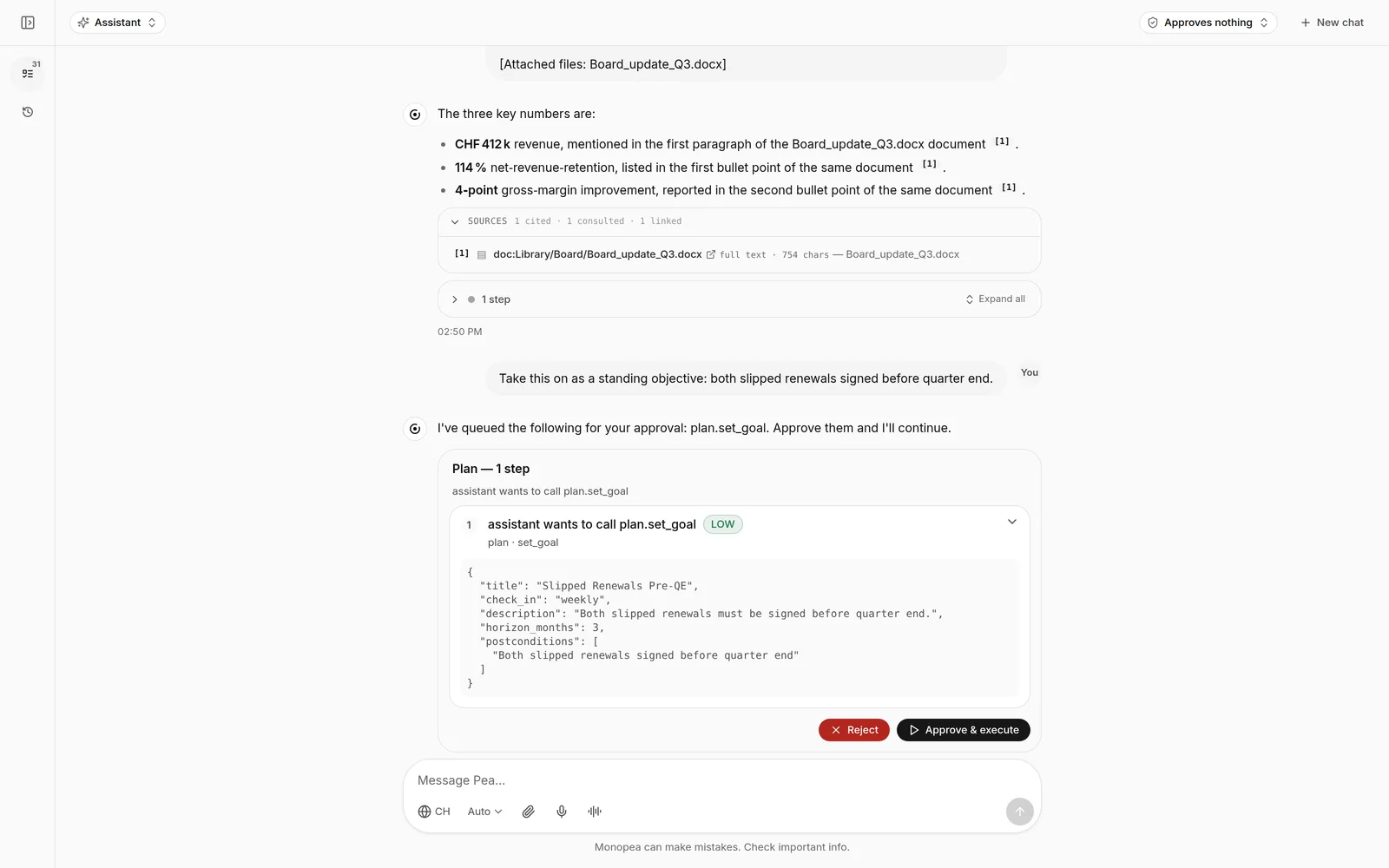
The autonomy is real, and so are the controls. A run in flight can be steered with a message and stopped on command, and it cannot take an ungated outward action: when a run reaches a mutation-capable call, it blocks on a proposal and waits for you like everything else.
01 / MECHANISM
From objective to sequenced work
Give the agent a goal — “keep the CRM clean”, “ship the monthly update” — and it breaks the objective into concrete tasks with order and dependencies, then works the plan. As tasks complete or conditions change, it re-sequences and continues toward the objective rather than waiting for the next instruction.
Nothing about the plan is a black box: you can see how the objective became steps, how far each step has moved, and the reasoning behind each move — all on the record.
- Objectives broken into concrete, ordered tasks with dependencies
- The plan adapts as work completes and context shifts
- Every step and its reasoning is visible
02 / MECHANISM
Runs that work while you don’t
Goals can run on schedules: recurring jobs, deadline-driven work, and background progress that continues while you are offline. A scheduled run behaves exactly like an interactive one — same memory, same tools, same gate — it just starts itself, works the next tranche of the plan, and leaves its trail in the activity feed for the morning.
This is where governed autonomy earns its keep. An overnight run that reaches a risky action does not improvise: the call becomes a pending proposal, the run blocks, and the work resumes the moment you decide — approval is a wake-up signal, not a lost thread.
03 / MECHANISM
Steer it mid-run. Stop it instantly.
A running goal is not a black box you wait out. Send a message and the instruction folds into the work in flight — add a constraint, change priorities, correct a wrong turn — without restarting. Tell it to stop and it stops immediately, along with everything it set in motion.
And because outward actions still pass the approval gate, “autonomous” never drifts into “unaccountable”: the run is free to plan, gather, and draft at full speed, and held to a human decision at exactly the moments that touch the world.
- Redirect work in progress with a message — no restart
- A stop command halts the run and everything it spawned, immediately
- Mutation-capable actions still become proposals, even mid-run
Why it matters
What it changes in practice.
01
Delegate outcomes
Hand over an objective, not a checklist. The agent plans and drives the steps.
02
Progress around the clock
Scheduled runs continue the work overnight — and block on the gate instead of guessing at risky calls.
03
Never out of reach
Steer with a message mid-run; stop instantly, everything included.
FAQ
Goals & autonomous runs, in short.
How autonomous is it really?
Can I stop a running agent?
What happens if a scheduled run hits something risky overnight?
Can I see the plan?
Keep exploring
Delegation & sub-agents
Big jobs fan out to sub-agents that run in parallel — every one of them inheriting the same approval gate, and all of them stoppable at once.
ReadApproval gate
Default-deny control: mutation-capable tool calls become pending proposals and wait for your decision before anything is dispatched.
ReadAudit trail & live activity
Every proposal, decision, and dispatch on a signed, tamper-evident record — with a live view of what is running right now.
ReadStart with everything gated. Open it up as you go.
Open a workspace, give the agent a task, and approve what it proposes. Stored in Switzerland, processed in the EU.